CYBERSECURITY MONTH 2026

Generative AI is now part of everyday work: people use it to write, summarize, translate and analyze. The EU regulation on artificial intelligence, the AI Act, supports this shift with a requirement that is simple to state: help teams understand the tools they use. This is the purpose of its Article 4, dedicated to AI literacy. The text changed in 2026. Here is what it requires today and how to meet it with practical measures.
What Article 4 requires today
Article 4 has applied since February 2, 2025. In its current version, it provides that providers and deployers of AI systems take measures to support the development of AI literacy among their staff and the people who use these systems on their behalf.
These measures take into account each person’s technical knowledge, experience, education and training, the context in which the systems are used and the people affected by these uses. Under the regulation, the deployer is the organization that uses an AI system under its own authority in a professional setting. Many companies and public administrations fall into this category as soon as their teams use AI tools.
What the 2026 reform changed
The 2026 EU reform of the AI Act, adopted as part of a package simplifying digital rules and in force since mid-July 2026, rewrote Article 4. The first version asked organizations to ensure a sufficient level of AI literacy. The new wording focuses on the measures to take and states that the obligation does not require guaranteeing a specific level for each person.
The text is now built around three points:
- For organizations: AI literacy remains an obligation of providers and deployers, centered on appropriate measures.
- For public authorities: the European Commission and the Member States support these efforts, especially for SMEs, in particular by publishing practical examples.
- For harmonization: the European Artificial Intelligence Board adopts recommendations based on European competence frameworks.
National market surveillance authorities have enforced Article 4 since August 2, 2026.
What remains essential: appropriate, documented measures
The new wording brings flexibility: each organization chooses measures proportionate to its uses. It also calls for clarity: identifiable measures, adapted to each profile and recorded. The European Commission also maintains a repository of practices from public and private organizations, a useful source of inspiration.
Three practical measures to move forward
1. Start from real uses. List the AI tools used in the organization, approved or not, and the situations where they are used: writing, recruiting, development, customer relations. This map steers the program toward what matters for your teams.
2. Build a program by profile. Useful habits vary by role:
- All employees learn to use AI with judgment, check an output and protect the data they share with a tool.
- Exposed roles, such as finance, purchasing, executive assistants or recruiting, practice verifying an unusual request, a familiar voice on the phone or a candidate who seems too perfect.
- Technical teams get into the habit of removing code, secrets and personal data before using any public tool.
- Leaders understand what AI changes, for the organization and for attackers.
Short, regular formats, combined with hands-on scenarios, make these habits last. Your internal rules, such as an AI policy or a list of approved tools, belong in the program too.
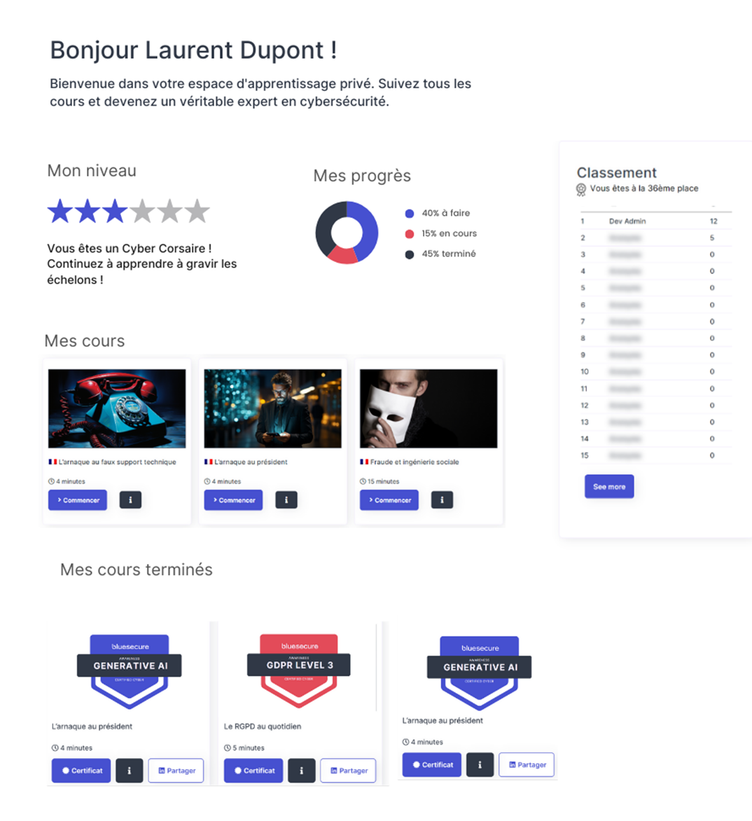
3. Keep a record. Keep a history of your actions: audiences, topics covered, dates, completion rates, certificates. This tracking supports your internal reviews and your discussions with stakeholders, and it shows how the program progresses over time.
Points to watch
AI literacy is one part of the regulation among others. The inventory of AI systems, their classification by risk level and the obligations specific to high-risk systems fall under other processes. Your legal department confirms how your organization is classified and the scope of the obligations that apply.
The quality of a program shows in everyday actions: content checked before it is shared, sensitive data kept out of a public tool, an unusual request reported. These habits are what help the organization progress.
Key takeaways
- Article 4 of the AI Act has applied since February 2, 2025 and was rewritten by the 2026 EU reform of the AI Act, in force since mid-July 2026.
- It asks providers and deployers to take measures to support AI literacy, adapted to people and uses, with no minimum level imposed on each individual.
- National market surveillance authorities have enforced it since August 2, 2026.
- A regular, documented program built by profile fits this approach.
To build this program with your teams, discover our approach to AI literacy.
Want to structure AI literacy in your organization? We build a program by profile with you, documented for your audits.
Sources
- AI Act Service Desk, Article 4: AI literacy (amended text), accessed 10/24/2026.
- European Commission, AI talent, skills and literacy (updated 10/13/2026), accessed 10/24/2026.