CYBERSECURITY MONTH 2026


Engaging awareness makes people want to come back. It lets them live a situation, gives them room to try, fits into their teams’ rhythm and shows the progress made together. Here are five practical levers to get there, whether you are launching a program or want to give it fresh momentum.
1. Tell a story
We remember what we have experienced. A story provides context, characters and stakes: the employee no longer reads a rule, they solve a situation.
An investigation to lead, a crisis to get through, an attack to foil: each scenario carries a specific habit. In CyberCrime™, for example, players find out who committed a cybercrime in the company, with which weapon and in which room. Each challenge they complete moves the investigation forward and anchors a good practice.
To take action: link each piece of content to a work situation your teams recognize, with clear stakes.
2. Turn mistakes into learning moments
Practice drives progress because it allows trial and error. In a game or a simulation, the employee makes a decision, sees the consequence and discovers the right action, in a risk-free setting.
This approach pays off: a study published in 2023 in Applied Sciences found that hands-on scenarios double learner engagement (MDPI, 2023).
The debriefing completes the experience. Right after the action, it explains what happened and why the right habit protects. This is the moment when the experience becomes lasting learning.
To take action: pair each simulation with a supportive learning page that explains rather than judges.
3. Choose short, regular formats
Habits are built through repetition. Sessions of a few minutes, available on a computer, tablet or phone, easily fit between two meetings.
Regularity matters more than length. A frequent touchpoint keeps attention alive, and fresh topics feed curiosity: a new type of scam, a use of AI, a situation while traveling.
To take action: plan a calendar of short sessions over the year, with themes that follow the news.
4. Create shared highlights
Shared moments build momentum. A booth in the lobby, a talk with live demonstrations, a team escape game or a virtual reality experience create memories and conversations that carry on within teams.
These highlights also reach employees that digital formats reach less: field teams, production sites, people without a dedicated workstation.
A crisis escape game such as BlackOut™ illustrates this dynamic: as a team, participants face the dilemmas of a crisis unit and leave with a clear stance in case of an incident.
To take action: schedule one or two highlights in the year, for example during European Cybersecurity Month in October.
5. Share progress with teams
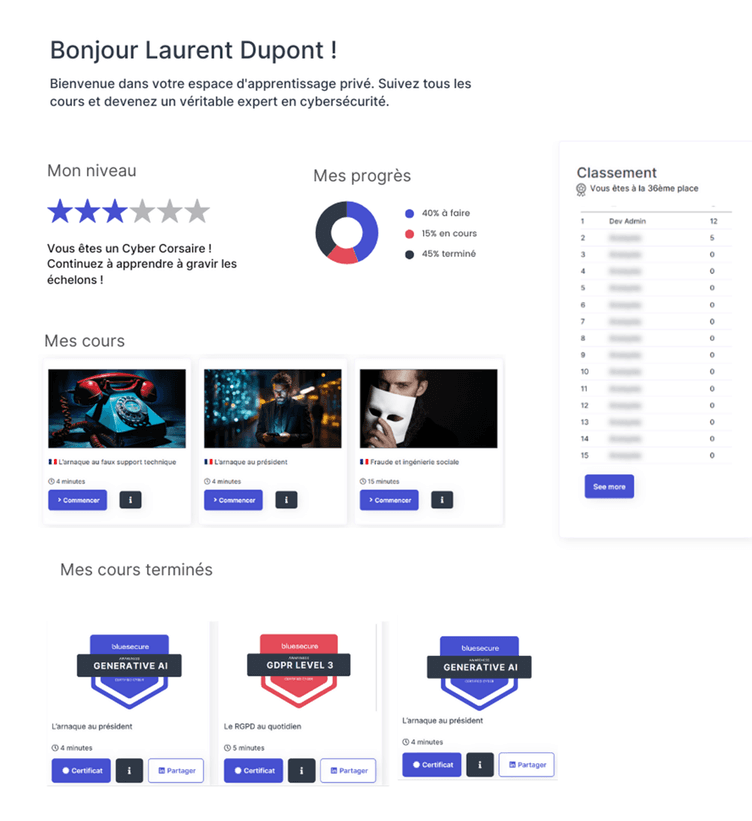
Seeing your own progress is motivating. Badges, certificates, friendly team leaderboards: recognition values everyone’s effort.
Reporting is the best indicator of all. Every suspicious message reported helps the whole organization, and saying so reinforces the habit. Sharing how reports or simulation results evolve, across a department or a site, turns awareness into a collective success.
On the management side, a consolidated indicator such as the BlueSecure Risk Index™ tracks the trajectory over time and helps target the groups that need support.
To take action: communicate collective progress regularly and thank the teams that report.
Summary
| Lever | What it brings | First step |
|---|---|---|
| A story | Context that gives meaning | Link each piece of content to a work situation |
| Room for mistakes | Learning through practice | A supportive debriefing after each simulation |
| Short formats | Habits kept alive | A regular calendar over the year |
| Highlights | Collective momentum | An event in October |
| Shared progress | Lasting motivation | Recognize reports |
To build a complete program, from initial assessment to measurement, read our guide: Gamified cyber awareness, the guide to building your program.
Learn more
The habits that protect.