 CYBERSECURITY MONTH 2026
Teach security by playing it
People remember what they lived through, not what they read. Escape games, investigation games, phishing practice and virtual reality turn abstract notions into concrete situations.
- micro-learning sessions
- 30+
- per short session
- 2 to 4 min
- for the escape game
- < 30 min
micro-learning sessions
per short session
for the escape game

Why choose a gamified approach?
Game-based awareness answers a simple problem: classic security training gets completed, then forgotten. A module watched passively leaves little behind. A situation lived through leaves a lot. Gamification turns abstract concepts such as phishing, social engineering and data leakage into practical challenges the employee solves themselves.
Active learning anchors knowledge more durably because it calls on decision rather than attention. Faced with a suspicious email, what protects you is not a definition but a reflex already practised.
Play also measures. Each format puts participants in a controlled setting where their choices are observable: you see which teams are comfortable, which need support, and which scenarios still leave the organisation exposed. Assessment stops being declarative and becomes factual.
Our gamified formats
Each format answers a specific need. They combine into a yearly programme or stand alone for a highlight such as Cybersecurity Month.

Cyber escape game
Cast as the attacker, learners take on a series of challenges to complete their mission in under thirty minutes.
CyberCrime investigation game
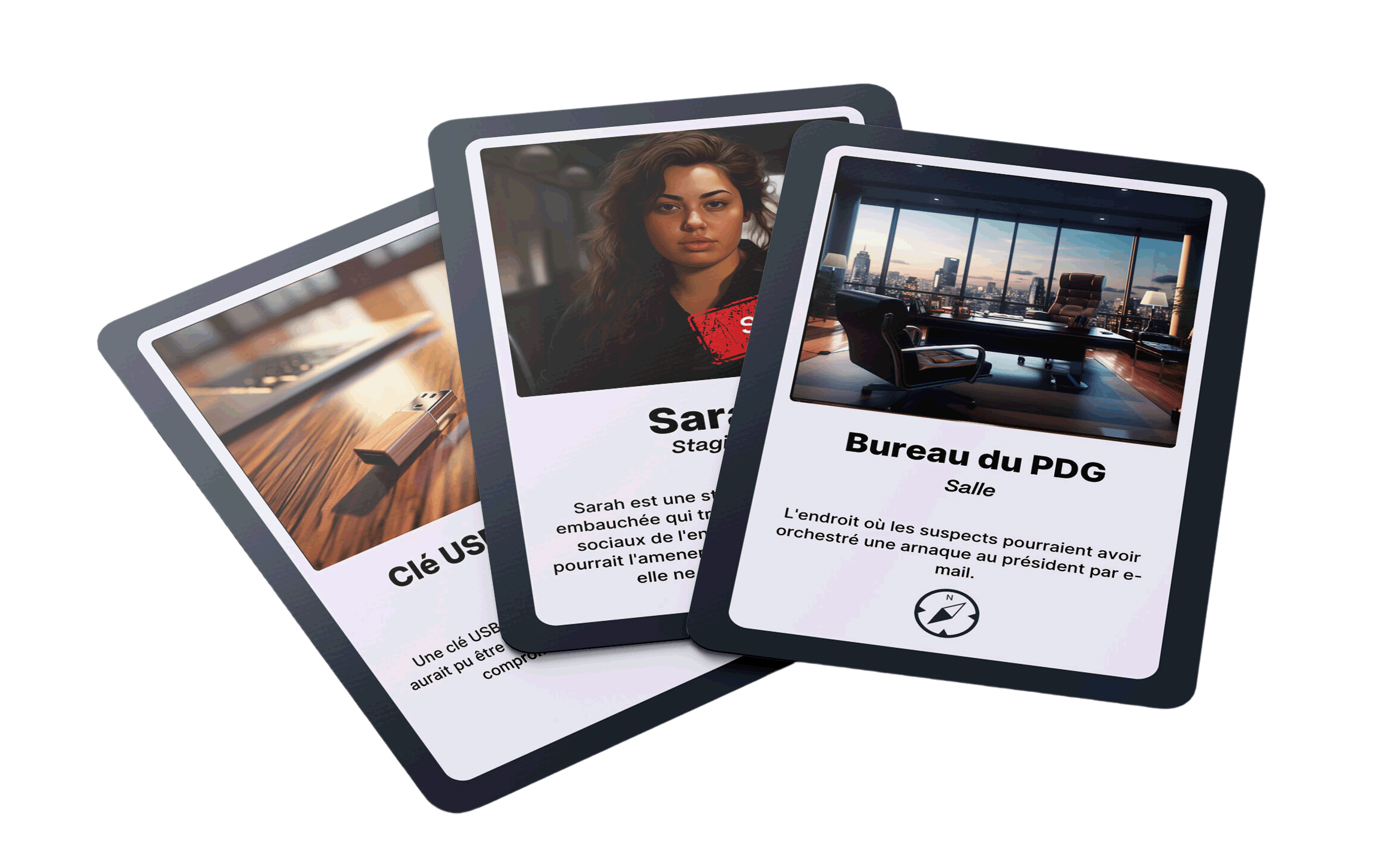
A series of mini-games where teams investigate to unmask the hacker. Available as a digital game and as a board game.
Phishing game
Interactive practice at spotting fraudulent emails: finding the clues that give a phishing attempt away.
Virtual reality
CyberOffice drops the user into a virtual office and radically changes how cyber risk is perceived.
Quiz challenge
Every module ends with a quiz that confirms the key principles were absorbed, with a participant ranking.
Micro-learning
More than 30 sessions of 2 to 4 minutes, plus advanced paths of 20 to 40 minutes for those who want to go further.
Phishing simulation
Realistic scenarios tailored to your sector, measuring actual vigilance rather than the declared kind.
BlueScreen, the cyber escape game
Your teams take the role of an attacker trying to breach a hospital. To succeed they must clear a series of challenges drawn from real incidents: a weak password, an unlocked workstation, a booby-trapped attachment. Reversing the roles is what makes the exercise stick. A threat is better understood once you have tried to use it.
- Short enough to fit a team meeting
- Playable on site or remotely
- Hospital scenario, transposable to other sectors

CyberCrime, the investigation game
CyberCrime offers realistic scenarios that draw participants into security puzzles. The aim goes beyond entertainment: it builds a shared security culture and a concrete grasp of the threats. Teams investigate together and uncover the culprit. The game exists as a digital experience and as a board game, for organisations that would rather gather their teams around a table.
- Played solo or as a team
- Digital version and board game version
- Designed for an awareness highlight
CyberOffice, awareness in virtual reality
CyberOffice is an immersive experience that changes how cyber risk is perceived. The user explores a virtual office and spots the everyday lapses: an unlocked screen, a sensitive document left in view, an abandoned USB stick. The headset removes the distance between the rule and the situation. What was an instruction becomes a gesture.
- Ideal for an event or an internal fair
- Immediately usable, no technical knowledge needed
- Leaves a lasting impression

Frequently asked questions
- How long does a gamified session last?
- It depends on the format. Micro-learning sessions run 2 to 4 minutes and fit inside a working day. The escape game takes under thirty minutes. Advanced paths run 20 to 40 minutes. Investigation games suit a longer team slot.
- Is any special equipment needed?
- Not for the online formats: a browser is enough, on desktop or mobile. Only virtual reality needs headsets, which we provide for events. The investigation game also exists as a board game, with no equipment at all.
- Do these formats suit non-technical teams?
- That is exactly what they are for. The scenarios start from everyday situations such as an email, a phone call or a USB stick, not from technical notions. No prior knowledge is required.
- How are results measured?
- Each module ends with a quiz, and the paths feed individual tracking: progression, badges, certificates. Phishing simulations complete the picture by observing actual rather than declared behaviour. You get a view by team and by scenario.
- Can the scenarios be adapted to our sector?
- Yes. Phishing scenarios are tuned to your activity and your habits, and the games can be transposed to your business context. Tell us about your scope and we will propose a combination of formats.
See the content in real conditions
Thirty minutes is enough to judge for yourself: we have you play one format and we look together at what it reveals.