 CYBERSECURITY MONTH 2026
Smishing
Train users against fraudulent SMS with credible mobile scenarios: delivery, banking, internal support, authentication or HR urgency.
- email, mobile, field and voice
- Multi-channel
- based on observed behavior
- Retargeting
- contextual pages and feedback
- Education
email, mobile, field and voice
based on observed behavior
contextual pages and feedback
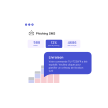
What is SMS phishing, or smishing?
SMS phishing, also known as smishing, is a technique attackers use to lure their targets into an action that compromises the organisation's infrastructure. The message lands on the phone, often a personal one, where vigilance is lower than in front of a work inbox.
SMS offers the attacker two advantages: it is short, so it leaves no room for the clues that usually give away a fraudulent email, and it is read almost immediately. A shortened link looks normal there, where it would raise doubt elsewhere.
To help you run your awareness campaign, we built into the BlueSecure platform a tool for scheduling SMS phishing campaigns and analysing the results.
How the attack unfolds
The attacker sends a message carrying a malicious link. The target opens the SMS and clicks, granting access to sensitive data. That data then serves the attacker: identity theft, diverted payment, access to a work account. Training your teams means breaking that chain at the first link, the only one the user still controls.
- A message carrying a malicious link
- One click, and access to sensitive data
- Exploitation: identity or money stolen
 A message carrying a malicious link
What the campaign helps you test
Scenario
Assess mobile reflexes where attention is shorter and links are harder to inspect.
Targeting
Create delivery, payment, badge, MFA or support scenarios aligned with your organization.
Reporting
Measure clicks and conversions from mobile devices.
Analysis
Retarget exposed groups with short, actionable reminders.
Deploy with minimal friction
- Mobile scenarioShort message, tracked link and responsive educational landing page.
- Audience listGroup targeting while respecting internal rules and consent requirements.
- CampaignScheduled delivery, click tracking and result segmentation.
- RemediationShort content to learn how to verify a mobile link.
Frequently asked questions
- Who are SMS phishing campaigns for?
- Every employee with a work phone number. That is the natural perimeter for this channel, and it often overlaps with the most mobile populations, therefore the most exposed.
- Why raise awareness of SMS specifically?
- Because reflexes learned on email do not transfer by themselves. Someone careful in front of their inbox can click without thinking on a link received by SMS, simply because the context feels personal rather than professional.
- Can the scenarios be customised?
- Yes, several scenarios are available and fully customisable. You edit the landing page as well as the training page shown to people who are caught.
- How are target lists built?
- From an Excel file or by synchronising with your Active Directory. You then schedule the campaign whenever you choose and follow the statistics in real time.
- Is the solution GDPR compliant?
- We apply a personal data protection policy in line with GDPR principles. Privacy impact assessments are carried out regularly to maintain a high level of data security day to day. Our AFNOR-certified DPO oversees ongoing compliance, in particular data minimisation and respect for individual rights.
Build a campaign around your real exposure
BlueSecure can combine this channel with the other Phishing 360 channels depending on your risk profile: email, SMS, QR code, USB, physical mail, physical intrusion, vishing and voice deepfake.